---
title: How to Organize a Studio Tour (Toolkits For the Arts)
description: How to Organize a Studio Tour. Studio tours offer a fun way to bring artists and the community together. By bringing the public into the studio, these events promote the local arts community and can offer an intimate and meaningful purchasing experience.
---
[Skip to content](https://help.wvcreativenetwork.org/knowledge-base/how-to-organize-a-studio-tour-toolkits-for-the-arts#main-content)
[More support](https://help.wvcreativenetwork.org/knowledge-base/kb-tickets/new?hsLang=en) [Customer portal](https://help.wvcreativenetwork.org/tickets-view?hsLang=en)

Open main navigation
Close main navigation
- [More support](https://help.wvcreativenetwork.org/knowledge-base/kb-tickets/new)
- [Customer portal](https://help.wvcreativenetwork.org/tickets-view)
- [Contact us](https://westvirginiacreativenetwork.mysites.io/contact-us/)
[Contact us](https://westvirginiacreativenetwork.mysites.io/contact-us/)
How can we help you?
- There are no suggestions because the search field is empty.
1. [West Virginia Creative Network](https://help.wvcreativenetwork.org/knowledge-base?hsLang=en)
2. [For Arts Supporters](https://help.wvcreativenetwork.org/knowledge-base/for-arts-supporters?hsLang=en)
3. [Creative Placemaking](https://help.wvcreativenetwork.org/knowledge-base/for-arts-supporters?hsLang=en#creative-placemaking)
September 15, 2025
# How to Organize a Studio Tour (Toolkits For the Arts)
## Studio tours offer a fun way to bring artists and the community together. By bringing the public into the studio, these events promote the local arts community and can offer an intimate and meaningful purchasing experience. This toolkit is designed to provide an overview of the logistics and benefits of studio tours, and offer practical steps for organizing a studio tour and helping artists prepare and participate.
Download our complete Toolkit For the Arts here: https://tamarackfoundation.org/wp-content/uploads/2020/06/4.-Organize-a-studio-tour.pdf
### Why Organize a Studio Tour?
A studio tour is a coordinated event in which local artists in a region open up their studios to the public. Each tour stop is often accompanied by insight and conversation from the artist, a demonstration of their craft, and an opportunity for visitors to purchase directly from the artist, perhaps learning about the inspiration and methods used unique to that piece.
Both artists and the public benefit from open studio tours. Studio tours can spark meaningful interactions, inspire creativity, forge connections, and, yes, promote sales. Whether a local artist is well-established or just getting their foot in the door, participating in a studio tour is an excellent way to engage with each other and visitors, as well as for visitors to explore the variety of work being created right in their town that they might otherwise not even be exposed to.
Studio tours can draw in tourism and become far-reaching social events that foster and maintain an appreciation for and participation in a vibrant arts scene, improving the cultural, economic, social, and individual prosperity of a community.
### Who Organizes a Studio Tour?
Studio tours are often arranged by arts groups or other organizations. They can also exist as standalone events organized by an informal group of artists in the community. In fact, many arts organizations actually spawn from such events as studio tours. (Learn more about forming an arts advocacy group in Toolkit 1: Create an Arts Organization or Toolkit 2: Form an Artist Cooperative.)
### West Virginia Studio Tours
Any neighborhood with an artist community can host a studio tour. Here are a few that occur in West Virginia:
#### Berkeley Springs Studio Tour (Morgan County) berkeleyspringsstudiotour.org
Berkeley Springs Studio Tour, Inc. is a nonprofit formed specifically to promote the arts in the Berkeley Springs area. The organization works with local arts groups to hold a free, weekend-long, self-guided driving tour through Morgan County once per year in autumn.
#### Over the Mountain Studio Tour (Jefferson County) overthemountainstudiotour.com
Over the Mountain Studio Tour, celebrating its 30th year in 2019, occurs throughout Jefferson County on the second weekend of November. The tour features an assortment of media and working spaces. In addition to the November tour, they also host a summer show which features presentations, receptions, anecdotes, and celebration of arts and artists all in one location.
#### Trails and Trees Studio Tour (Berkeley County) beckleyartcenter.org
The Trails and Trees Studio Tour spreads across Berkeley County, is free, and self-guided. In 2010, several artists joined forces to encourage art-centric appreciation and tourism in the area.
### Where to Start
Think artists in your area would love to open their studios to admirers, eager questions, and potential customers? Would your community enjoy a behind-the-scenes look at how some of their favorite work is created, engage with the artists, discover new creators, and perhaps take a piece home with them? Here are some suggestions on where to start.
#### DO YOUR HOMEWORK
##### Gather your team
Community-wide affairs, such as studio tours can draw the interest of many different individuals—not just artists. Reach out to any existing arts or community organizations to gauge interest or even see if a similar even is hosted on an informal level already. Specifically, you will need a handful of individuals to serve as a core planning team for your organization. Because a studio tour must be organized with the individual artists’ studios in mind—which are often in their own homes—it’s a good idea to make participating artists fundamental to your planning team.
##### Find your artists
To have a studio tour, you need some studios—and some artists! Your community might already have a formal or informal artists' cooperative or organization. Start your search for artists by investigating what groups or individual artists operate in your intended region (whether that be your town, your county, or any other specified area). Often, the individual artists are already members of the coalitions you come across, so simply referring to a group’s directory should yield a good starting point. Additionally, local artists can be found through their personal websites, social media presence, gallery, or even artwork being featured in various shops and restaurants. Send out a press release through local media and your own website or newsletter that calls for artists.
##### Application and jury process
Restricting tour stops to juried artists who work with predetermined materials will ensure the level of quality of work and, therefore, experience and credibility the tour delivers. As your studio tour grows in popularity and participation, this may become more of a relevant consideration. Generally, studio tours require an application, which includes:
• descriptions and images of their artwork and medium;
• photos of their studio;
• a demonstration of the process they plan to use;
• notice of any potential safety hazards, either in the studio or in the art process; and
• address/location of their studio on the area of interest map. (Berman, 2010a)
#### MAKE A PLAN
After you have your core committee and collection of artists interested in participating, it’s time to establish realistic expectations, timelines, and general logistics for a successful studio tour. Aim to start planning approximately one year or so in advance—maybe longer if it’s a new event and you’re still getting the logistics sorted.
##### When do you want your studio tour to be held? Consider some of these factors.
**The proximity of studios.** Is it a driving tour, or are all studio stops within walking distance? This could dictate which is more appropriate. For example, you may decide to have a walkable summer outdoor festival-like event or a driver-friendly, more holiday-themed tour in the winter. Or you can plan for multiple events, each with a different feel.
**Frequency.** Many studio tours do not occur on as regular a basis as some other art-based events, such as pop-up markets or art walks. Instead, organizers often opt for an annual, biannual, or seasonal schedule, depending on the availability and interest of both the public and the artists. It might be reasonable to plan for one event in your first year and play by ear from there.
**Time of year.** Assessing the locations of your participating studios—like the aforementioned proximity of the physical studios—may play into the time of year you decide to organize the studio tour. The seasonal weather, personal scheduling, and other events going on in the area should help inform the ideal time to organize the tour.
##### Plan ahead!
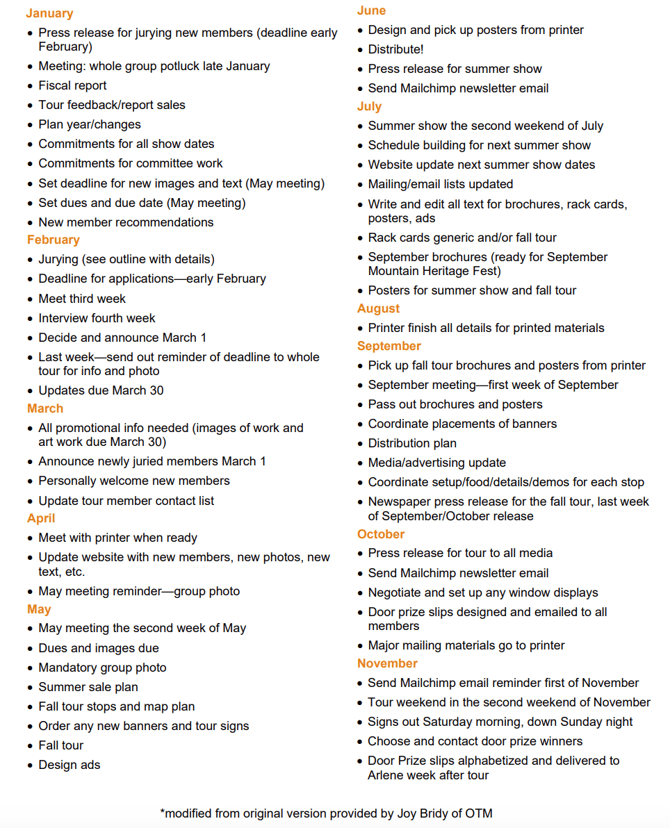
Successful studio tours require extensive preparation. From coordinating artists' schedules and jurying tour members to designing, printing, and distributing promotional material, a solid time-line that can be loosely (or closely!) followed will help the process go more smoothly.
#### Over the Mountain Studio Tour Sample Timeline
The following page contains a modified version of the timeline the Over the Mountain Studio Tour members refer to each year. The group holds two main events: a summer show and a fall studio tour in November, so consider how the tasks are allocated for each event. You can use this timeline as a general idea for the types of tasks that should be accomplished and a time reference for their completion.
### Promoting Your Studio Tour
#### Branding
Before you can start marketing, you need to consider how you want the tour to be perceived by the public and any potentially cooperating groups. Is there something unique or meaningful that unites your participating artists together? Maybe some commonality in medium, theme, cultural, or regional characteristics? Whatever you choose, ensure the name is memorable and representative of the community/artists it operates with. For example, the “Trails and Trees Studio Tour” is a catchy, short name that employs alliteration to invoke imagery of the natural world which, if not the subject matter of the artists’ work, is at least a dominant theme for the region. On the other hand, the more straightforward “Berkeley Springs Studio Tour” is inclusive, versatile, and informative! Any associated graphics, such as a logo, brochure themes/images, or something else, should likewise follow the same general features. Consistency is key.
#### Marketing Materials
Marketing literature, such as brochures, flyers, websites, and social media pages, should maintain a consistent theme that is in line with the other elements already in place, such as the name, logo, and other branding elements. Have a marketing plan established and follow it with respect to the timing of your event. What does your plan entail? With printed materials such as posters, flyers, newspaper ads, rack cards, and mailing items, ensure you allow enough time for the design, printing, and distribution of them. Refer to the Over the Mountain timeline for an idea of when you might consider you should get certain materials in place. Advertise for both the event attendees and new artist participants!
#### Online Presence
Most folks get their news through a share or mention on some online platform. Make an easily accessible website exclusively for the studio tour or as a page on your organization’s existing site. Be sure to include:
• Basic event information, including times, location, and directions from nearby cities.
• Participating Artists: A page (or series of pages) should include biographies and artist statements, portraits, and photos of example work for each artist.
• Newsletter signup: Include a widget in which individuals can submit their email address/contact information to receive updates and information on the event.
Remember to keep the site updated with new artists, dates, and so forth!
#### Consider hosting an evening reception as a central social hub during the art walk
This can help form connections among city residents as well as give them an opportunity to engage with all participating artists. The reception area can serve as a central hub, providing maps/brochures, sales guides, refreshments, music, activities, and anything else you think might entice the public or prove to be useful.
#### Create a map of the studio tour stops, including the address, business name, and, ideally, the artist(s) being hosted.
A map is essential to the experience and success of your studio tour. You can accomplish this with a custom Google Map, which can be interacted with conveniently on patrons’ phones or computers. You may also wish to do a simple map graphic with locations marked. Ensure the map is updated to accurately reflect participants for each event. Because a studio is often in someone’s home, exteriors of the studio part of the house are helpful:
• Reference this example of an interactive map from Over the Mountain: [overthemountainstudiotour.com/online-map](http://overthemountainstudiotour.com/online-map)

### Help Prepare Your Artists
An open studio visit is intended to be informative, engaging, and profitable—for the artists and the public. A visit should be viewed as an experience.
#### Demonstrations
Have artists be prepared to exhibit their creative process through a demonstration of some aspect of their work. For example, a painter may continuously paint throughout the day or hold particular viewing times for a more educational, pointed lesson of sorts. A ceramics artist may even have visitors try their hand at a potter’s wheel. Have artists prepare a statement about their work, both in technique and inspiration, and be willing to engage in discussion with visitors.
#### Portfolio and exhibit pieces
When first starting out, requiring a minimum number of display pieces (including those for sale) may not be helpful, but it’s a good idea to set a number of items for artists to shoot for in order to make the tour stops worth the effort for guests—and to ensure there is enough inventory for most potential buyers as they trickle in throughout the day.
#### Some extras
To further enhance the experience and make the stop a place where visitors feel like they can linger to converse, take in the art, and potentially make a purchase, have your artists consider including supplementary entertainment, such as a book of their portfolio, music in the background, and some light refreshments on hand.
#### Ensure studios are safe for visitors
Read later for more on liability insurance, but vet all artists for safety in their materials, process, and the studio itself. Establish some guidelines that artists must adhere to in order to be included on the tour.
#### What if an artist cannot host visitors?
Some artists may not be able to hold a studio stop at their actual studio for any number of reasons, ranging from not having the space or parking, community limitations, entry codes, or otherwise. In these cases, participating artists who do have the additional available space may offer it up, so multiple artists can be located at the same station. Appropriate venues may also rent out space to artists.
#### Follow-ups
Especially when you first start the tours, collecting and integrating feedback into future studio tours is imperative. Consider handing out feedback cards that ask what interested visitors most enjoyed, intent to purchase, things that were appreciated, things that could be improved, and contact information (email for newsletter/mailing list and location for demographics).
### Concerns & Considerations
#### Exclusivity
When artists have art in a gallery, they may have an exclusivity agreement with the gallery. Exclusivity precludes an artist from individually showing and selling work directly to customers, making them competition to the gallery. Ensure each artist represented in a gallery confirms they can participate in an open studio tour by examining their exclusivity contract and/or communicating with the gallery:
• Artists should speak with the gallery to outline any exclusivity restrictions. These generally include the exclusive geographic area (city, county, state boundaries) and the exclusive collections or types of work exclusive to the gallery.
• Regardless of how the contract reads, artists should still inform the gallery that they would like to participate in a studio tour. Galleries may consider the circumstances of the tour to breach the contract, or they may simply appreciate the open communication.
• An individual artists’ positive relationship with a gallery can also translate into a positive relationship with the tour itself. Artists should reinforce their respect and goodwill toward the gallery and frame the studio tour as an event that can benefit both the artist and the gallery. Request promotional literature for the gallery to distribute at the studio visit, and assure the gallery, the artists will direct clients to the gallery. (Berman 2010)
#### Safety, insurance, and liability
While accidents can happen anywhere, they are more likely to happen in areas that have potentially hazardous materials, processes, or equipment. Even a studio that is not necessarily suitable to host a group of onlookers can be cause for concern. Because many studios are within personal homes, artists should refer to their homeowner's policy to assess the coverage they have. Usually, public liability/business insurance is not included, so you will need to investigate the level of coverage that you recommend studios have. You can release yourself, as the organizing group, of liability and make it the owner’s responsibility to obtain the appropriate insurance. (Arlington Visual Art Studio Tour 2019)
While providing refreshments at your event is a great way to attract and keep patrons, liability issues can arise if items are homemade. It’s best to keep refreshments store-bought or from restaurants. Artists selling their work may require a business license. Make sure artists do some research on what legal considerations they might need to take into account: [avvo.com/legal-guides/ugc/artistsguide-to-starting-a-business](http://avvo.com/legal-guides/ugc/artistsguide-to-starting-a-business)
#### Remember, a studio tour is by and for artists and art-admirers in the community.
Over the Mountain Studio Tour is organized around core beliefs that all participants follow and keep in mind. The first belief is that all the legwork that goes into the planning and operation of the tour is done by the participating tour members. The second is that the tour does not accept any advertising funds; rather, the members pay dues and seek out grants from arts organizations or CVB, which helps to keep the event free to the public. And, finally, the third core belief is that, just like art, logistics can evolve as members, techniques, audience, and circumstances change. The group invites fresh ideas and perspectives, and modifies their operations according to ability, desire, and demand. (Bridy, 2019).
### Sources
Berman, Harriete Estel. 2010a. Professional Guidelines: Open Studios: Artist Checklist. [https://harrieteestelberman.com/open-studios-artist-checklist](https://harrieteestelberman.com/open-studios-artist-checklist)
Berman, Harriete Estel. 2010b. Professional Guidelines: Open Studios: Guide for Art Organizations. [https://harrieteestelberman.com/open-studios-organizations](https://harrieteestelberman.com/open-studios-organizations)
Bridy, Joy. 2019. Personal correspondence.
Over the Mountain Studio Tour. 2019. Over the Mountain. [https:// www.overthemountainstudiotour.com/](https://%20www.overthemountainstudiotour.com/?hsLang=en)
Open Studio Tours. 2019. Planning resources.[https://www.openstudiotours.com/ planningresources.html](https://www.openstudiotours.com/%20planningresources.html)
- [For Artists](https://help.wvcreativenetwork.org/knowledge-base/for-artists?hsLang=en#main-content)
- [Getting Started](https://help.wvcreativenetwork.org/knowledge-base/for-artists?hsLang=en#getting-started)
- [Artist Account Support](https://help.wvcreativenetwork.org/knowledge-base/for-artists?hsLang=en#artist-account-support)
- [Artist Directory Support](https://help.wvcreativenetwork.org/knowledge-base/for-artists?hsLang=en#artist-directory-support)
- [Artist Opportunities](https://help.wvcreativenetwork.org/knowledge-base/for-artists?hsLang=en#artist-opportunities)
- [Toolkits & Career Resources](https://help.wvcreativenetwork.org/knowledge-base/for-artists?hsLang=en#toolkits-career-resources)
- [Creative Skill Development & Enrichment](https://help.wvcreativenetwork.org/knowledge-base/for-artists?hsLang=en#creative-skill-development-enrichment)
- [Creative Business Resources](https://help.wvcreativenetwork.org/knowledge-base/for-artists?hsLang=en#creative-business-resources)
- [Funding & Grants](https://help.wvcreativenetwork.org/knowledge-base/for-artists?hsLang=en#funding-grants)
- [For Customers](https://help.wvcreativenetwork.org/knowledge-base/for-customers?hsLang=en)
- [FAQs](https://help.wvcreativenetwork.org/knowledge-base/faqs?hsLang=en)
- [General](https://help.wvcreativenetwork.org/knowledge-base/general?hsLang=en#main-content)
- [Creative Placemaking](https://help.wvcreativenetwork.org/knowledge-base/general?hsLang=en#creative-placemaking)
- [Accessibility](https://help.wvcreativenetwork.org/knowledge-base/general?hsLang=en#accessibility)
- [Support](https://help.wvcreativenetwork.org/knowledge-base/support?hsLang=en)
- [For Arts Supporters](https://help.wvcreativenetwork.org/knowledge-base/for-arts-supporters?hsLang=en#main-content)
- [Creative Placemaking](https://help.wvcreativenetwork.org/knowledge-base/for-arts-supporters?hsLang=en#creative-placemaking)
- [Arts Advocacy](https://help.wvcreativenetwork.org/knowledge-base/for-arts-supporters?hsLang=en#arts-advocacy)
- [For Organizations](https://help.wvcreativenetwork.org/knowledge-base/for-organizations?hsLang=en#main-content)
- [Accessibility](https://help.wvcreativenetwork.org/knowledge-base/for-organizations?hsLang=en#accessibility)
- [Disaster Preparation & Emergency Planning](https://help.wvcreativenetwork.org/knowledge-base/for-organizations?hsLang=en#disaster-preparation-emergency-planning)
[](http://wvcreativenetwork.org)
© West Virginia Creative Network. Designed in Collaboration with [WD Strategies](https://www.wd-strategies.com/).
[mailto:email@email.com](mailto:email@email.com)